
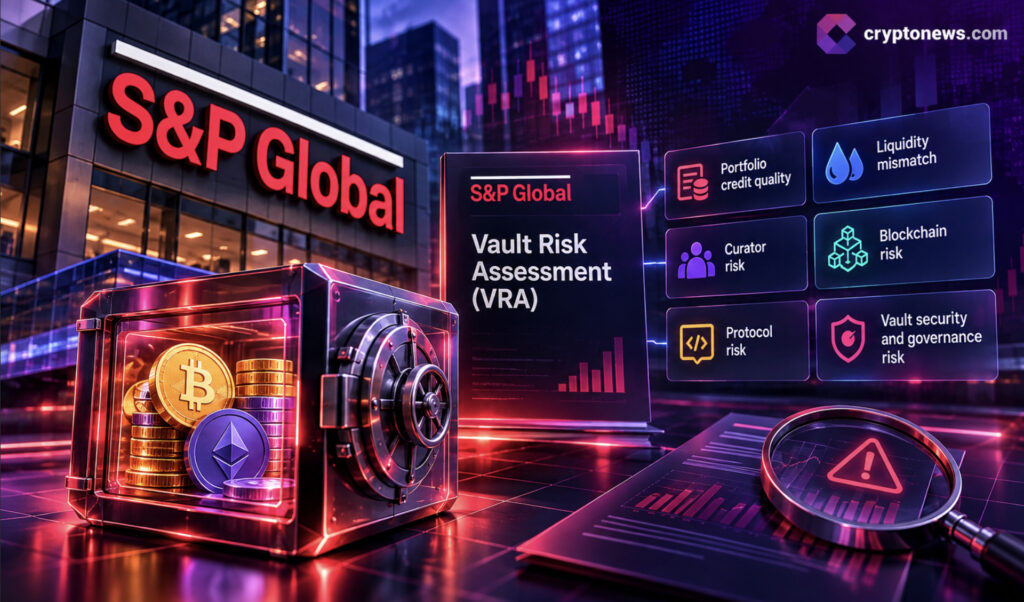
S&P Global Ratings has rolled out its Vault Risk Assessment (VRA), a forward-looking tool designed to evaluate key risks affecting investors in blockchain-based lending vaults. The initiative aligns with the rapid growth of the sector, where deposits climbed to roughly $10 billion by September 2026, up from $1.5 billion two years prior.





The framework applies traditional institutional risk evaluation methods to the fast-evolving DeFi lending space. It focuses specifically on assessing potential impairment risks rather than gauging vault yields or conventional credit ratings of issuers.
Digital asset vaults aggregate investor funds and deploy them on-chain using predefined strategies. These strategies may be automated via smart contracts, managed by human operators, or a hybrid of both. S&P likens these structures to actively managed fixed-income funds.
The reported figures indicate a 6.7x increase in deposits from September 2024 to September 2026, highlighting the growing capital at stake as vaults make strategic decisions around asset eligibility, liquidity, and management practices.
How S&P Global Vault Risk Assessment Works
The VRA offers a forward-looking view of the overall risk of impairment to an investor’s stake in a lending vault. It evaluates six core dimensions: portfolio credit quality, liquidity mismatch, curator risk, blockchain risk, protocol risk, and vault security and governance risk.
Vault performance isn’t solely determined by the assets currently held. The model also accounts for portfolio credit health, liquidity dynamics, and risks tied to curators, underlying blockchains, protocols, and governance structures.
Investors receive share tokens denoting their proportional claim on vault assets and earnings. While this structure packages lending exposure into an on-chain vehicle, the risk profile isn’t inherently transparent—the strategy and operational context significantly influence outcomes.
S&P clearly defines the boundaries of the VRA: it is not a credit rating and doesn’t assess yield potential.


Risk Clarity Over Returns
The company emphasizes shifting from mere transaction transparency to comprehensive risk transparency, aiming to help institutions enhance investment oversight and refine vault selection processes.
S&P Global Ratings President Yann Le Pallec noted rising demand for independent risk evaluations that bridge traditional finance with decentralized markets as digital assets gain institutional traction. This makes the VRA a valuable tool for institutional investors navigating on-chain lending opportunities.
This differentiation is crucial for participants comparing vaults to conventional fund structures. A risk classification provides a consistent benchmark across multiple criteria but doesn’t convert the underlying exposure into a standard fixed-income product or equate yield with risk.
S&P plans to roll out initial Vault Risk Assessments in upcoming announcements. However, its October 4 release didn’t specify a timeline, list of target vaults, or eligibility criteria, signaling that the launch primarily introduces the analytical framework.
