

Iran Conflict Polymarket Betting: $33.5M Wagered on a 2027 Blockade Conclusion


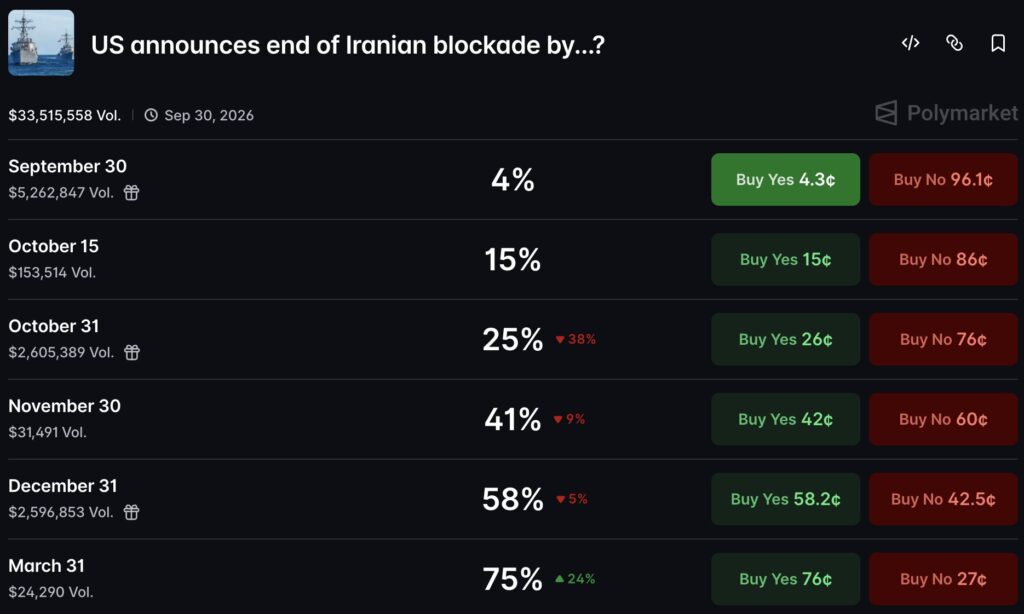
Polymarket’s Iran conflict odds indicate a U.S. declaration terminating the naval blockade of Iran not before March 31, 2027, with the contract showing 74.5% Yes versus 25.5% No as of Tuesday morning, September 29, per live platform data.
Since its launch, the market has accumulated over $33M in total volume, and the fact that the highest-probability outcome sits nine months ahead prompts a clear question: if U.S.-Iran negotiations are truly advancing, why are informed bettors wagering on postponement instead of a swift resolution?
Have a Hunch? It Could Yield Big Returns on Polymarket
Iran Conflict Polymarket Odds: What Diplomatic Context Are Traders Monitoring?
Valuations are shaped by continuing talks, per a September 24 Reuters report. American and Iranian negotiators are weighing a staged agreement whereby Tehran would reopen the Strait of Hormuz in return for the U.S. lifting its economic blockade. Neither side is eager to surrender leverage; Washington keeps up economic pressure, while Tehran holds sway over a vital global oil shipping lane.
Yet present circumstances don’t meet resolution criteria per market rules. Polymarket stipulates that only formal U.S. government declarations qualify for contract settlement, ruling out conjecture or conditional remarks.
This gap between market sentiment and rigid contractual requirements is pushing outcome expectations further out. Watchers can also observe how the Iran-U.S. ceasefire proposal influences Bitcoin price forecasts, mirroring wider risk appetite.
What the Complete Contract Ladder Reveals
Polymarket’s blockade market includes several deadline contracts assessing the likelihood of a qualifying announcement on particular dates. These contracts cannot be merged into one event probability, since each constitutes a separate wager.

Collectively, they imply traders anticipate the diplomatic process will stretch past the current news cycle. Once a qualifying announcement occurs, it settles as “Yes,” even if the blockade persists afterward or a partial concession follows; such concessions don’t count.
This distinction matters, as previous U.S.-Iran ceasefire deals have rapidly collapsed, showing a pattern of limited resolutions, akin to wagers on the Bab-el-Mandeb Strait that demand precise triggers for settlement.
Have a Hunch? It Could Yield Big Returns on Polymarket
Aggregate volume across the event reaches $33,486,973, with liquidity of $519,322 as of the latest update at 09:07:57 UTC Tuesday. The March 31, 2027 contract – now the pricing leader – holds relatively light volume of only $24,290, so its 74.5% Yes reading reflects a smaller capital pool than the headline figure implies.
The bulk of trading has flowed through nearer-term contracts already priced for near-certain No outcomes: the September 30 deadline alone has attracted $5,238,179 in volume against a scant 3.3% Yes price, while October 31 has seen $2,604,557 traded at 24.5% Yes.
December 31 falls between the two extremes at $2,596,836 in volume and 57.9% Yes. This distribution indicates most capital has already been committed to betting against a rapid resolution, leaving the March contract as a relatively low-conviction, low-liquidity outlier at the ladder’s peak, a dynamic worth considering alongside how Polymarket’s NATO-linked contracts have likewise displayed thin markets yielding attention-grabbing but fragile probability readings.