
XRP Ledger AMM Draws Attention as SEC Opens Door to Tokenized Stocks



The newest XRP development has put the XRP Ledger back in the focus after the SEC created a new route for tokenized stocks to be traded through automated market makers. Its September 17 ruling established a temporary exemption allowing certain blockchain-based venues to support tokenized U.S. stocks in permissioned AMM liquidity pools.


The ruling does not name XRP, Ripple, or the XRP Ledger directly. Instead, it sets out a framework for Tokenized Securities Venues, under which qualifying platforms may run AMM-based markets subject to specified conditions.

Why might this be bullish for XRP? The XRP Ledger already includes a native AMM. Its AMM amendment became active on Mainnet in March 2024, adding built-in liquidity pools to the network’s existing decentralized exchange and making the SEC’s latest decision especially relevant to the XRP ecosystem.
Earn $50 While Entering the $300K EdgeX Prize Draw
SEC Opens a Conditional AMM Route for Tokenized Stocks
The SEC’s Innovation Exemption offers temporary relief from certain securities rules for Tokenized Securities Venues. These platforms can use automated market makers and liquidity pools to connect buyers and sellers of tokenized National Market System stocks.
The exemption is conditional, not a blanket approval of tokenized equities across the crypto market. The SEC said participating venues must use permissioned systems and meet defined investor-protection requirements.
Tokenized stocks must grant holders the same rights and privileges as the corresponding traditional shares, including benefits such as dividends and voting.
The framework also lets the original issuer of a stock object if a third party tokenizes its shares. Trading must halt if trading in the underlying stock is suspended on its primary listing exchange.
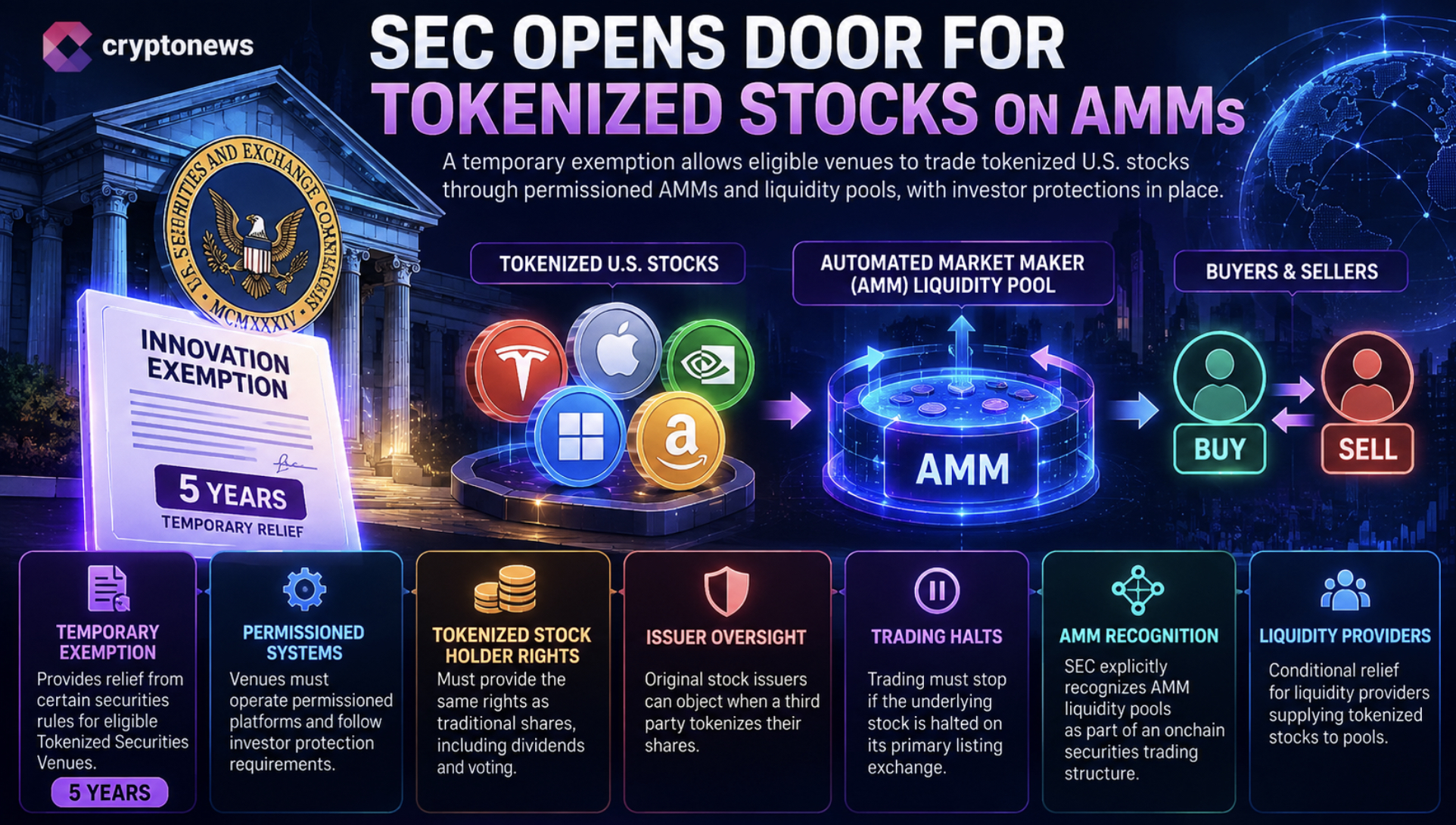

For crypto markets, the most significant element may be the SEC’s clear acknowledgment of AMM liquidity pools within an onchain securities-trading structure.
The SEC’s order also provides conditional relief for certain liquidity providers that supply tokenized stocks to these pools. The exemptions are scheduled to remain in effect for five years, giving regulators time to monitor how the market evolves.
This has sparked renewed discussion about blockchain networks that already possess native AMM infrastructure.
XRP Ledger’s Built-In AMM Moves Into Focus
This is where the XRP Ledger enters the conversation. XRPL’s AMM functionality was added through the XLS-30 amendment, which went live on Mainnet on March 22, 2024.
Unlike a standalone application built on top of the network, the AMM is integrated into the XRP Ledger’s decentralized exchange. Users can form liquidity pools for pairs of assets, supply liquidity, and receive LP tokens representing their positions.
According to XRPL’s documentation, its DEX can merge order-book liquidity with AMM liquidity when executing trades, so transactions can use whichever route offers the better exchange rate. That native design is becoming more pertinent as regulators begin addressing onchain securities markets.
However, it would be premature to claim that the SEC has approved tokenized stocks on XRPL. The Innovation Exemption is technology-neutral and lays down requirements for eligible Tokenized Securities Venues rather than approving individual blockchains.
For XRP holders, the importance is therefore centered on infrastructure rather than an immediate new use case for XRP.
If regulated tokenized-equity markets eventually grow on public blockchains, networks with existing AMM and DEX infrastructure could have a ready foundation for development. XRPL already has that base, while the SEC has introduced a regulatory framework that expressly contemplates AMM-based trading.
The next question is whether financial firms will actually select public networks such as XRPL for these markets. The SEC has opened the door, but the industry still needs to walk through it.
For now, the XRP story is less about an SEC endorsement of XRP and more about a regulatory development that could make XRPL’s existing AMM architecture increasingly relevant to tokenized assets.
Trade XRP on Bybit for a Chance to Win a $1,000 USDT Airdrop